2016
Nature takes its revenge
In December and January, the weather remains unusually mild. On our return from MILLESIME BIO, we arrive in SANTENAY with a temperature of 16°C, even though it is the end of January. It's enough to make you despair of winter! There is no cooling down in February, and the first warm days of March trigger the vine's vegetative cycle (the vine weeps). These weather conditions allow for early pruning (around November 12), which will be carried out without any interruption due to weather conditions and will be completed by the end of
April, May, and June will be very wet, with total rainfall over three months equivalent to half a year, or 425 mm, compared to an annual average of 800 mm.
After no frost during the winter months and heavy rain during the growing season, we were expecting a difficult campaign in our organic fight against vine diseases (mildew and powdery mildew). But that was before the frost arrived. It came without warning on the morning of April 27. A frost of unprecedented magnitude across the whole of Burgundy. All the conditions were in place for maximum damage: rain the day before, clear skies with high humidity at the end of the night, and temperatures of -2°C in some places. This white frost on damp vines was short-lived, but the early morning sunshine greatly exacerbated the damage...
The damage assessment on the afternoon of the 28th is very serious (Yvette and Jean François CHAPELLE are currently in Belgium). The early-ripening Chardonnay vines seem to be the most affected, but large areas of Pinot Noir, which ripens much later, have also been damaged. Our plots in LADOIX and ALOXE CORTON are completely scorched. The same is true for MEURSAULT and POMMARD. At first glance, the damage appears to be less severe in CHASSAGNE MONTRACHET and SANTENAY.
The plots affected by frost are more susceptible to MILDEW, and little by little the leaves are attacked by the fungus and the disease sometimes spreads to the few existing bunches. But more seriously, the disease also attacks vines that have not been affected by frost. From May 7 to August 4, we protect our vines with copper and sulfur, making around 12 tractor passes, whereas in a normal year we carry out 8/9 treatments.
Flowering takes place in extreme and unfavorable conditions: numerous coulures, especially on Pinot, and great irregularity from one vine to another. We estimate full flowering around June 25, which means we can expect the harvest around September 25!
Return of dry, hot weather in the last week of June The intense heat in mid-July causes the first signs of sunburn, as the grape clusters have not yet become accustomed to the sun.
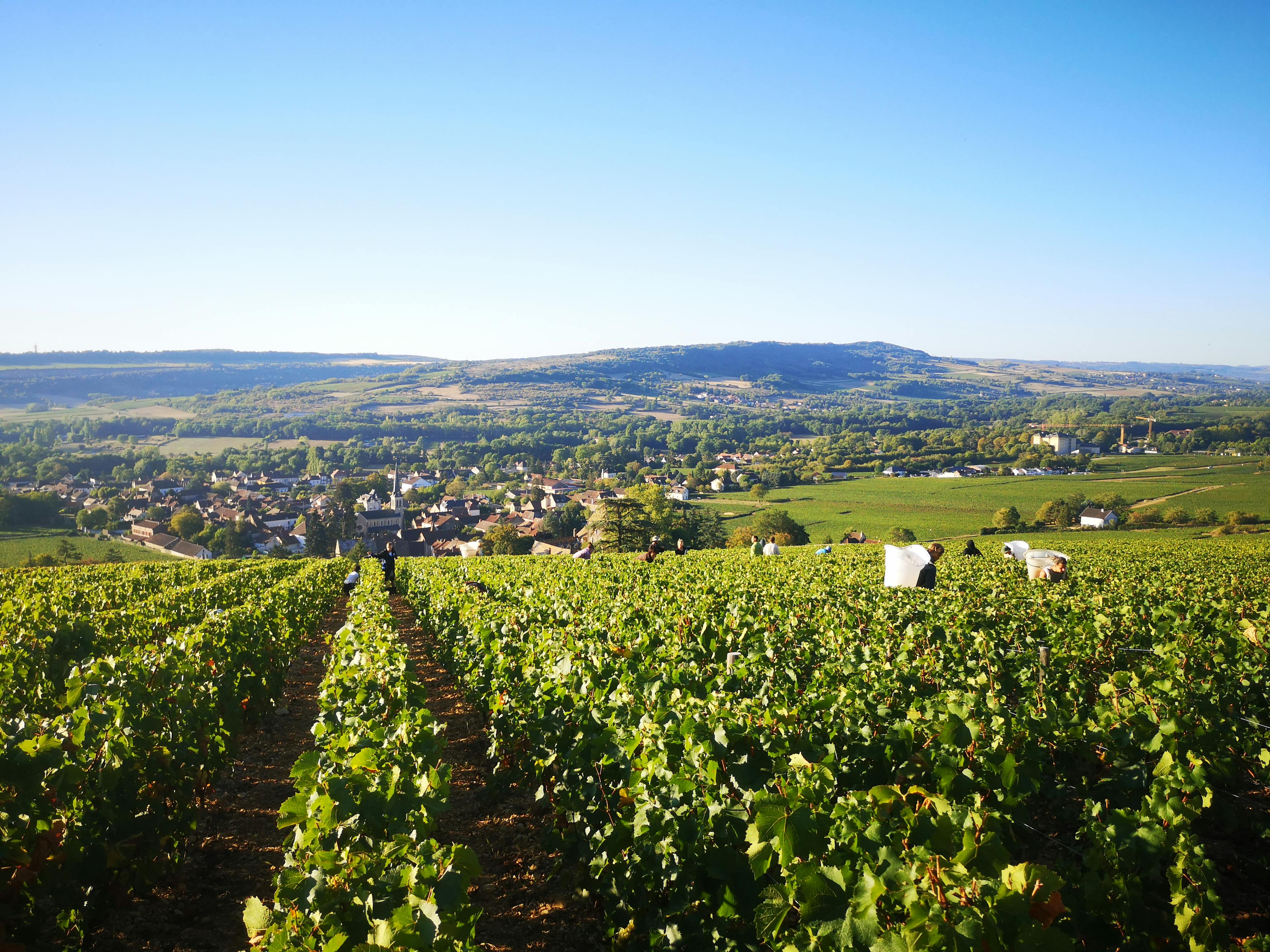
We begin harvesting on Wednesday, September 21, with a small team of only 24 pickers, compared to the usual 36. Picking begins in the area most affected by winter frost: BOURGOGNE BLANC, LADOIX BLANC, LES VRIS, LES LOLIERES, and our two Aloxe Corton plots: LES CRAS and LES CITERNES. As expected, the harvest in this area north of Beaune is disastrous. There are no grapes on BOURGOGNE BLANC and LADOIX and very few on ALOXE CORTON. We are only doing well on LES LOLIERES and LADOIX BLANC! With ideal weather, sunny but not too hot, and no rain, the harvest continues with our BOURGOGNE ROUGE and BOURGOGNE ALIGOTE from Puligny. We suffered from very severe mildew pressure on this large 2-hectare plot, and the quantity is not what we had hoped for!
Returning to Chassagne Montrachet and Santenay, the harvest is more abundant, especially on our Chardonnay plots. However, there was a big surprise in CLOS des CORNIERES and BOTAVEAU, where poor flowering conditions had a major impact on the harvest, which this year will be a third of a normal year! As has been our custom since 2009, we are finishing with POMMARD. Here too, the winter frost has left its mark and we will struggle to fill three barrels with the juice from our grapes, whereas this plot usually produces 7-8 barrels. In the end, the 2016 harvest will be one of the smallest (174 pieces) ever produced on the estate after 2012 (145 pieces), compared to an average harvest of 282 pieces over the last 15 years.
This small harvest will be of very high quality.
Tasting notes red
The red wines, aged in oak barrels or casks, have deep colors and are very fruity. The tannic structure is opulent without being aggressive. The personality of each plot is clearly expressed.
Tasting notes white
upcoming